Buyer's Edge
Why do two reps of the same watch cost so differently?
By IndiaRepTime · current as of November 2026
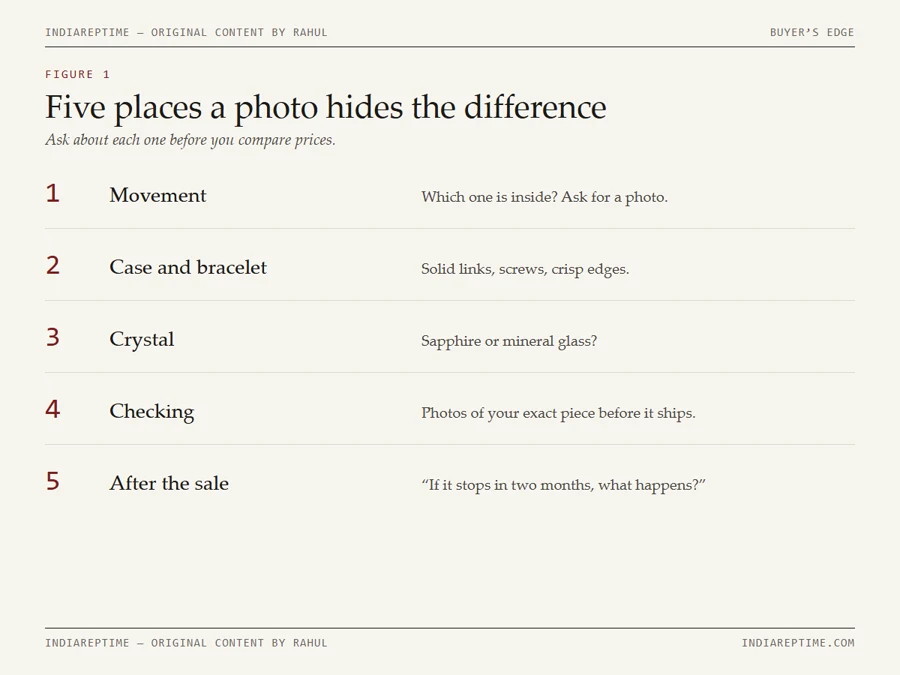
Two reps of the same model can look identical in a listing photo and be very different watches. The difference is in five places a photo hides: the movement, the case and bracelet, the crystal, the checking before it ships, and what the seller does after the sale. A low price almost always means one or more of those was skipped. Ask about each one before you compare prices.
We sell reps at the upper end, so read this knowing that. We have left prices off this page on purpose. They change, and the questions do not.
What is inside it?
The movement is the largest single difference.
- Better reps of popular models use an automatic movement built to the same layout as the original, so the hands, date and crown work the same way.
- Cheaper ones use a general-purpose automatic. It keeps time, but the date may change differently, the seconds hand may tick at a different rate, and the watch may be thicker to fit it.
- Some use a general-purpose movement with decorated plates on top so it looks like the original through a glass caseback. That is not a defect, but you should know which one you are buying.
Ask: which movement is in this piece, and can I see it in a photo?
What is it made of?
Steel grade, how the case is cut, and how the bracelet is finished. On a better rep the edges are crisp, the brushed and polished surfaces meet in a clean line, and the bracelet links are solid and held by screws. On a cheaper one the edges are soft, the bracelet rattles and the clasp feels thin.
Ask: are the links solid, and are they held by screws or pins?
What is the crystal?
Sapphire resists scratches. Mineral glass does not. Both look the same in a photo. A coating to cut reflections, and a correctly magnified date lens where the original has one, are further steps that cost money.
Ask: is the crystal sapphire?
Was it checked before it shipped?
A careful seller photographs your exact watch before it leaves, and often puts it on a timing machine. That takes time and someone who knows what to look for. A seller who ships straight from a carton saves that cost, and you become the quality check.
Ask: will I get photos of my exact piece before I pay?
What happens if something is wrong?
A watch is a machine with a hundred small parts. Some arrive with a fault. What you are also paying for is a seller who answers the phone two months later.
Ask: if it stops in two months, what happens?
Is the expensive one always better?
No. A high price is not proof of anything. A seller can charge top money for a middling watch, which is why the five questions matter more than the number. A seller who answers all five with photos has earned a higher price. One who answers none has not, whatever he charges.
And the very cheap ones?
They exist, and they are a different product: lighter, thicker, with a basic movement and little checking. If the budget only reaches that far, buy it knowing what it is. Do not buy it because the listing used the same words as the better one. Our page on what “1:1” means covers that word.
What don’t we know?
- What any other seller’s watch contains. Only photos of the actual piece answer that.
- How long either kind will last. We have not found published figures. See how long does a rep automatic last.
Before you send money to anyone, read how to spot a scam seller.
Read next: