Movement Room
Rotor noise on a rep automatic: normal or a fault?
By IndiaRepTime · current as of November 2026
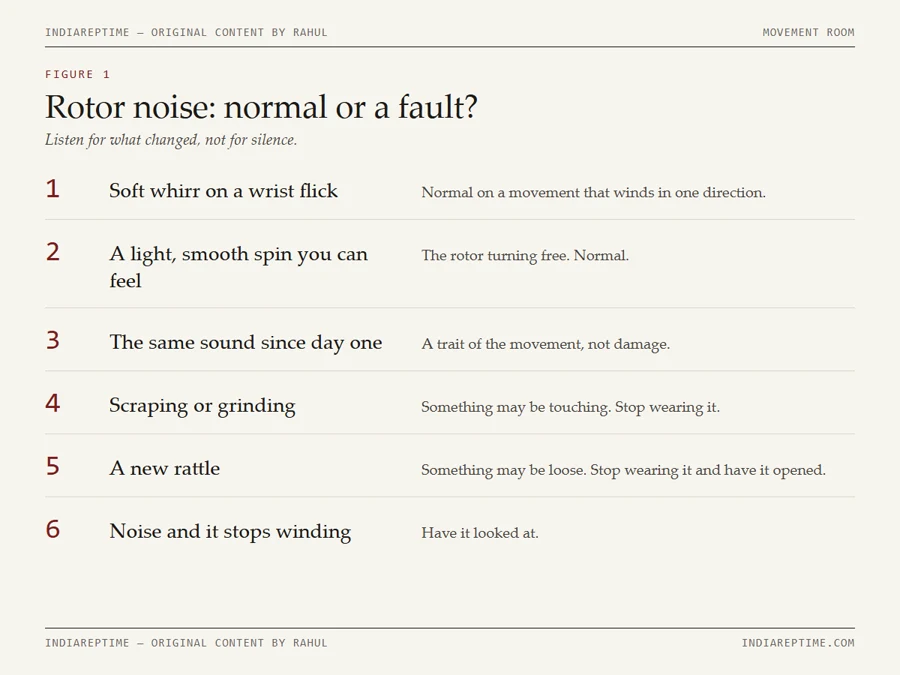
A soft whirr when you flick your wrist is normal on a movement that winds in one direction. The rotor spins free the other way and you hear it. Scraping, grinding, or a rattle that was not there last week is different. Stop wearing the watch and have it opened. Judge the change, not the volume.
What is the rotor, and why can you hear it at all?
The rotor is a half-disc weight on the back of the movement. It swings as your arm moves, and through a small set of gears it winds the mainspring.
It is metal turning on a bearing, so it makes some sound. In its teardown of the Miyota 9015, Monochrome describes the rotor as held by three screws and a central ball bearing. Our own Breguet 5177 review notes that the 9015 is described as having an audible rotor, more so through a display back. We did not assess the sound on ours.
Hearing it is not a fault on its own.
Why are one-direction winding movements louder?
SJX explained the two designs in July 2026. In a one-direction movement, the most common design uses a single reverser, which connects the rotor to the winding gears in one direction only. In the other direction the rotor is let go and spins freely. In a two-direction movement, two reversers send the energy into the winding gears whichever way the rotor turns.
A rotor that is let go is not driving the winding gears, so it turns faster. A Montres Breguet patent, written about winding mechanisms in general and not about the 9015, puts the result in one line: in the free direction “the weight rotates at a higher speed which produces an increased rolling noise”.
That is the whirr. It is the design, not wear. A quiet rotor does not make a better rep, and a loud one does not make a worse one.
Which movement is in my watch, and how do I find out?
The one we can name is the Miyota 9015. Monochrome’s teardown says it “is wound only in one direction as the rotor spins” and that in the other direction “it spins freely”. Miyota’s own product page says only “Automatic and hand winding”. Its specification sheet is a PDF we could not read today, so the direction here is Monochrome’s statement, not Miyota’s.
Two places we have found a 9015 in a rep:
- The Breguet 5177 rep sold as MKS V3 runs a decorated Miyota 9015. We confirmed it on our piece.
- Our ZF page describes ZF’s house engine as a decorated Miyota 9015 on a large share of its line, not all of it.
How to check yours:
- Display back. Look at the movement, not the print. On our Breguet rep the movement is printed “CAL. 777Q” and “SWISS”, and it is a Miyota. Our ZF page gives the balance as a tell: it sits where Miyota put it, not where the original’s does.
- Solid back. Ask what base movement is inside, or look the watch up in our list of movement bases by factory.
For other rep movements we have no sourced statement on winding direction, so this page names none.
Which sounds are normal?
- A soft, smooth whirr after a wrist flick. A US watch-repair guide lists a soft “whirring” or “spinning” noise as normal on an automatic. DIY Watch Club describes a healthy rotor as “a smooth running mechanical sound”.
- A light, smooth spin you can feel through the case. This is our reading of the free spin, not a sourced sign. A rotor that wobbles or drags is different: DIY Watch Club reads that as loose.
- The same sound since day one. Listen to the rotor on the day the watch arrives, when you run through the arrival checklist, so you know what yours sounds like.
Which sounds mean a fault?
- Scraping. DIY Watch Club, in a guide to Seiko rotors, describes it as a metallic sound that scrapes the case back or the movement, and reads it as a loose rotor. It warns a loose rotor might scratch either.
- A heavy metallic clunk against the case. The same repair guide says the rotor bearing may be worn, or the screw holding the rotor may have loosened.
- A new rattle. The same guide says that if a rattle is new or heavy, stop wearing the watch, keep it still, and do not shake it, work the crown or open the case.
- Noise, and the watch no longer winds on the wrist. We have no source for this one. Two symptoms together are worth a bench visit.
Something touching inside a watch can mark the parts each time it moves. Take it off.
What can a watchmaker do about it, and what can he not?
He can open the case and see what is touching. On the Seiko rotors DIY Watch Club writes about, a loose rotor screw can be tightened, and it warns that overtightening risks the thread. Leave it to a bench. A worn bearing would normally mean a replacement part. We have no source that says so for the 9015.
Parts are the catch. Our ZF page notes that ZF modifies the mainplate for its own date wheel, so a fresh Miyota 9015 is not always a drop-in replacement. See where to get a rep repaired in India.
Do not expect him to make a one-direction movement silent. The free spin is part of the design. For what does wear with age, see how long a rep automatic lasts.
What don’t we know?
- Which way the Dandong and Jinghe movements wind, and what their rotors turn on. We have not found it published.
- What Rolex says about its own rotor. Rolex’s pages would not open for us today, so this page says nothing about it.
- Miyota’s own wording on the 9015’s winding direction. Its product page gives none and we could not read the specification sheet.
- How loud one rep rotor is against another. We have not found a measured comparison.
Read next:
- Why does my automatic watch stop overnight?
- Submariner 41 on a small wrist: will it fit?
- Why are some reps thicker than the gen, and how do you check?
All reviews and guides · questions? talk to us
Got a question about this, or see it differently? Discuss it on r/IndiaRepTime, our subreddit for owners and first-time buyers.