Buyer's Edge
What does “1:1” actually mean on a rep watch?
By IndiaRepTime · current as of November 2026
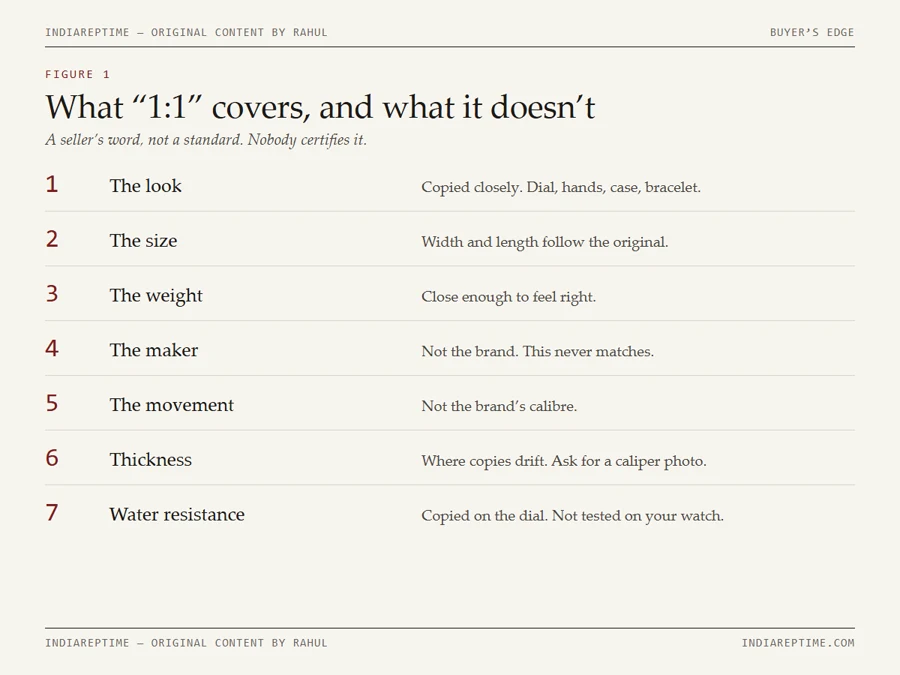
“1:1” is a seller’s word, not a standard. Nobody certifies it. At its most honest it means the watch was built to the original’s dimensions and looks the same on the wrist. It does not mean the watch is original, and it does not mean every part matches. A rep is not made by the brand, and a seller who lets you think otherwise is the first red flag.
We sell reps, and we say so to every buyer who asks. This page is the long version of that answer.
Is a 1:1 rep an original?
No. An original, which buyers call the “gen”, is made and sold by the brand. A rep is a copy made by an unrelated workshop. It carries no brand warranty, no brand service and no brand papers. If a seller offers “original box and papers” with a rep, those are copies too.
What usually does match?
On a good rep, the things you see and feel at arm’s length:
- The look. Dial layout, hands, case shape and bracelet style.
- The size. Case width and length are copied from the original.
- The weight. Close enough that it feels right in the hand.
- How it works. An automatic movement that winds, sets and changes date the way the original does.
What usually does not match?
- Who made it. Not the brand. This never matches.
- The movement. It may be built to the original’s layout, or it may be a different movement with decorated plates on top. Either way it is not the brand’s calibre.
- Thickness. This is where copies drift. On our caliper, one Cartier rep read 8.3 mm where Cartier publishes 7.3 to 7.5 mm for the original. Another, a Jaeger-LeCoultre rep, read 9.2 mm, the same as the original.
- Finishing under a loupe. Edges, printing and polishing look fine at arm’s length and less fine at ten times magnification.
- Water resistance. The number on the dial is copied along with everything else. It has not been tested on your watch. See where to get a pressure test in India.
- Special functions. On one rep we reviewed, the signature sleep mode of the original did not work at all.
How do you check a 1:1 claim?
Ask for evidence about your own watch, not the model in general.
- A caliper photo. Width and thickness of the piece being sold to you, next to the brand’s published figures.
- QC photos. Clear pictures of your exact watch before it ships: dial, date, hands, caseback, clasp.
- A timegrapher reading. How it is running today.
- A live video. The watch in hand, with your name on a slip of paper beside it.
A seller who has the watch can do all four in a few minutes. One who cannot is selling a picture.
Why do sellers use the word?
Because it is short, and buyers search for it. There is nothing wrong with the word as long as both sides know it means “a close copy”. The trouble starts when it is used to suggest “same as original”. It is not, and it cannot be.
What should an honest answer sound like?
Something like this: no, it is not an original. It is a high-grade rep with the same look, size and weight, and an automatic movement. Here are photos of your exact piece before you pay. If the answer you get is shorter or vaguer than that, keep asking.
What don’t we know?
- How any single rep will measure until it is on a caliper. Batches differ.
- How long a given rep will last. We have not found published figures, and we say so in how long does a rep automatic last.
For the other words you will meet on a listing, see rep watch words explained. For sellers who misuse them, see how to spot a scam seller.
Read next: