Buyer's Edge
How long does a rep automatic last, and what fails first?
By IndiaRepTime · current as of November 2026
We have not found published lifespan numbers for rep movements, so be wary of anyone who gives you a figure in years. What we can say: a rep automatic is a mechanical watch built on an Asian-made movement, usually Chinese, and it can be serviced and kept running like any other mechanical watch. What can end one early is often not wear. It is water, a drop, or a small part nobody could source.
We stock rep watches. We don’t have a count of how long ours have lasted, and we say so below.
Why is there no simple answer?
A mechanical watch does not have a fixed life. It has parts that wear, oil that dries, and rubber seals that age. Replace and service those, and it keeps going. Ignore them, and it stops. A rep is the same, with one difference: there is no official supply of spare parts.
What tends to fail first?
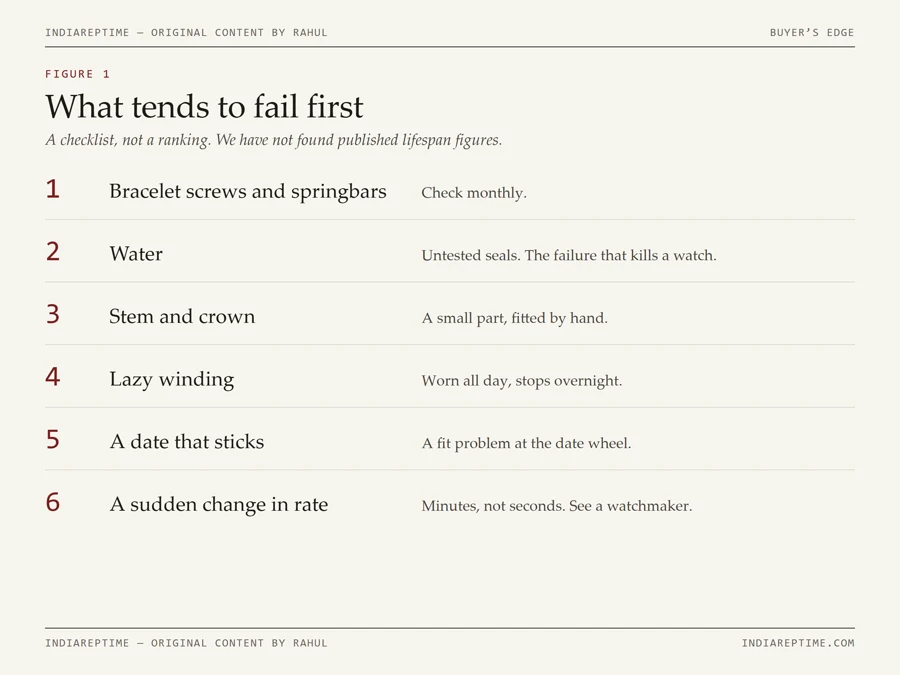
Six things to watch for. Nobody has counted which comes first, so this is a checklist, not a ranking:
- Bracelet screws and springbars. Screws back out, springbars tire. Boring, and the one you can prevent yourself. A monthly check does it.
- Water. The case has been opened at least once since anyone tested it. A watch that has not been pressure-tested is a gamble in a pool or the sea. Water is the failure that turns a small problem into a dead watch.
- The stem and crown. A snapped stem means you can’t set or wind the watch. The part is small, but it has to be fitted by hand.
- Lazy winding. You wear it all day and it still stops overnight. That is usually the automatic winding, not the whole movement.
- A date that sticks. A fit problem at the date wheel, not a movement failure.
- A sudden change in rate. Minutes a day, not seconds, fast or slow. Often magnetism, which usually makes a watch run fast, or a knock. This one needs a watchmaker.
Dials, cases and bezels are not on the list. They are either right when the watch arrives or they are not.
What shortens a rep’s life?
- Water without a test. See how to get it pressure-tested.
- Drops. A fall onto tile can bend a pivot or knock the rotor loose.
- Opening the caseback at home. Each time risks the seal and lets dust in.
- Magnets. Phone cases with magnets, laptop speakers, magnetic clasps on bags.
- Leaving it unserviced once it runs badly. Running a dry movement wears it faster.
What makes it last?
- A pressure test when it arrives and after every opening.
- A service when the timekeeping or the power reserve changes, not on a calendar alone. For mechanical watches in general, watchmakers commonly suggest a service every few years.
- A watchmaker who works on Chinese movements and keeps donor movements for parts. Our repair guide explains how to find one.
- Winding it by the crown now and then if you don’t wear it daily.
Can it be repaired when it does fail?
Usually, yes. Any competent independent watchmaker can open one. The question is parts. Spares come from donor movements of the same type. For the common movements that works. For a rare one it can mean a long wait.
What would we do?
Treat the first week as a test, get the pressure test done, check the bracelet monthly, and find your watchmaker before you need him.
What don’t we know?
- How many years, on average. We have not found a published figure, and we haven’t counted our own. If we do, we’ll put the number here.
- How the newest movements age. Some are under two years old. Nobody can know yet.
- Whether every part will stay available. That depends on factories that announce nothing.
Read next: