Buyer's Edge
Where to get a rep watch pressure-tested in India before you swim with it
By IndiaRepTime · current as of November 2026
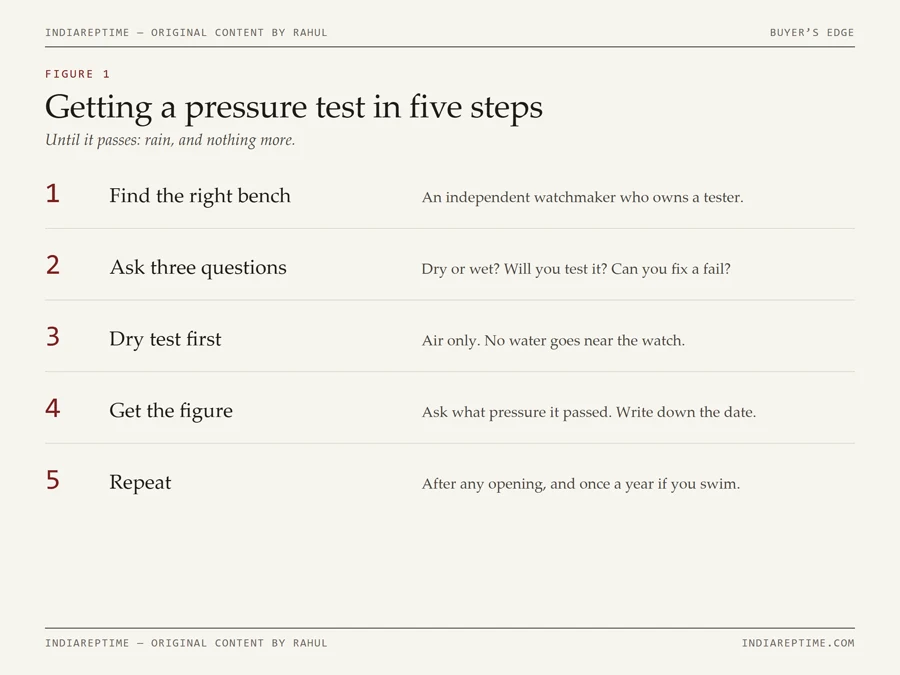
Go to an independent watchmaker who owns a pressure tester, not a brand service centre and not a mall kiosk. Ask for a dry test first. A pressure test takes a few minutes, and it is the only thing that tells you whether your watch is sealed. Until it passes, treat the watch as fine for rain and nothing more.
We stock rep watches. We don’t name shops here, because a list of names turns into a referral business. The questions below find the right place in any city.
Why test at all?
The depth printed on the dial describes a sealed watch that left a factory. Yours has been opened at least once since then, for the factory’s check or the seller’s. Every opening can pinch or shift a gasket, and you can’t see that from outside. Our swimming guide explains the numbers. This page is about getting the test done.
Who can do it?
- Yes: independent watch repairers who service automatic watches. The ones who work on Seiko, Citizen and Swiss watches, dive watches included, are the likeliest to own a tester, because a dive watch should be tested every time its caseback is opened. Not all of them do, so ask.
- Maybe: multi-brand service counters. Ask if they will test a watch they did not sell.
- No: brand service centres. They will refuse a rep, and it puts the staff in an awkward spot.
- No: kiosks that only change batteries and straps.
In a big city, start with the old watch-repair markets and ask around for whoever does “water resistance testing”. Call before you go.
What do you ask on the phone?
- “Do you have a pressure tester, and is it a dry one or a wet one?”
- “Will you test a watch you did not sell, and tell me the pressure you tested to?”
- “If it fails, can you change the gaskets and test it again?”
Tell him what the watch is. He will very likely know anyway, and being straight gets you better work.
Dry test or wet test?
- Dry test. The watch sits in a chamber of air. The machine changes the pressure and measures whether the case flexes the way a sealed case should. No water goes near the watch. Ask for this one first.
- Wet test. The watch is pressurised in air, then lowered into water, and the pressure is released. A stream of bubbles from the watch means a leak. It shows where the leak is, which is useful after a dry test fails. Done carelessly on a leaking watch, it can let water in.
What pressure should it pass?
Bench testers have limits, and many stop well below the number on a dive watch’s dial. That is fine. For swimming, ask him to test to the highest pressure his machine does, without going past the rating on your watch, and ask what that was. Write the figure and the date down.
What if it fails?
A failure is often a gasket: caseback, crown or crystal. Ask him to replace the one that leaks, grease it, close the case with a proper tool and test again. Do not accept “it should be fine now” without a second test.
How often?
- When the watch arrives, before any water.
- After anyone opens the caseback, every time.
- Once a year if you swim with it. Gaskets are rubber, and rubber ages faster in heat.
What still applies after a pass?
- Crown screwed fully down, always.
- No hot showers, saunas or steam. Heat and soap get past seals that pool water does not.
- Rinse in fresh water after the sea or a pool.
- A pass is for that day. It is not a rating for life.
What don’t we know?
- Which shops near you have a tester. We haven’t surveyed them, and we don’t name shops.
- What your watch will pass. Two watches from the same batch can test differently. That is the whole reason to test.
Read next:
- Rotor noise on a rep automatic: normal or a fault?
- Why does my automatic watch stop overnight?
- Why are some reps thicker than the gen, and how do you check?
All reviews and guides · questions? talk to us
Got a question about this, or see it differently? Discuss it on r/IndiaRepTime, our subreddit for owners and first-time buyers.