Movement Room
How accurate should a rep automatic be, and when does it need regulating?
By IndiaRepTime · current as of November 2026
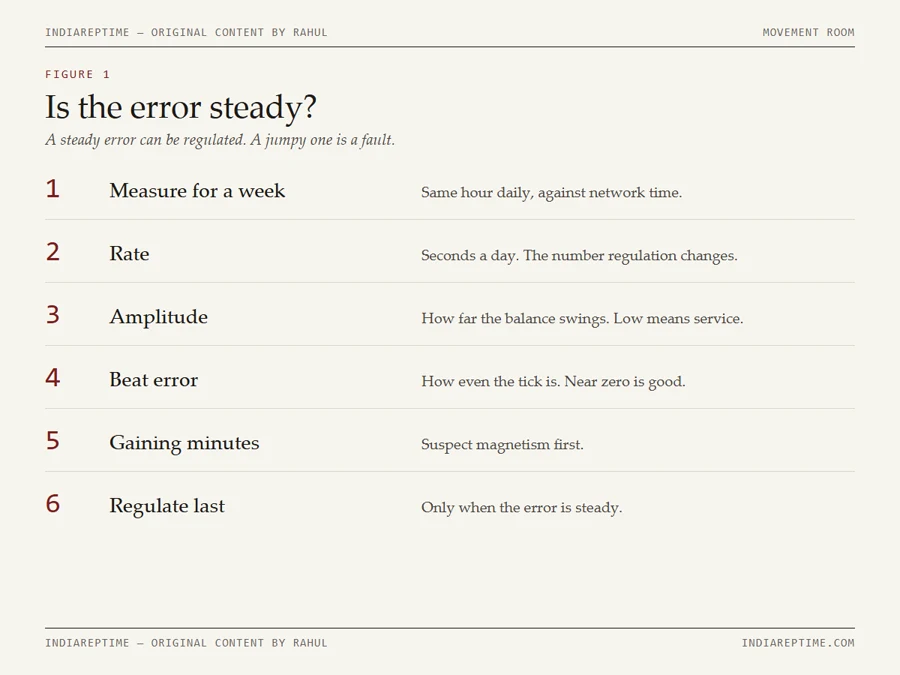
Nobody publishes an accuracy standard for reps, so judge yours the way a watchmaker would: by whether the error is steady. A watch that gains the same few seconds every day is healthy and can be regulated. A watch whose error jumps around, or that suddenly gains minutes, has a different problem and regulating will not fix it. Measure for a week before you decide anything.
What do the brands promise for their own watches?
Two published figures give a sense of scale. The Swiss chronometer test, COSC, passes a movement that averages between minus 4 and plus 6 seconds a day. Rolex states minus 2 to plus 2 seconds a day for its cased watches.
Those are promises for tested originals. A rep is not tested to either, and no seller’s “COSC” claim on a rep means anything.
So what is a fair number for a rep?
There is no official one. Our own working rule, and it is only ours: within about 10 seconds a day, steady, is fine to wear. Between 10 and 30 seconds a day, steady, is a regulation job. Minutes a day is a fault.
How do you measure it properly?
- Wind the watch fully and set it against a phone showing network time.
- Wear it as you normally would.
- Check it at the same hour each day for seven days. Write the difference down.
- Divide the total by seven.
One day tells you little. The rate changes with how much the watch is wound, which way it rests at night, and temperature.
What do the timegrapher numbers mean?
Sellers often send a photo of a timing machine. Three numbers matter.
- Rate, in seconds per day. Plus is gaining, minus is losing. This is the one regulation changes.
- Amplitude, in degrees. How far the balance wheel swings. A low figure on a fully wound watch points to dirt, dry oil or a weak mainspring, not to regulation.
- Beat error, in milliseconds. How even the tick and the tock are. Close to zero is good. Under about half a millisecond is commonly treated as fine.
A reading is taken in one position at one moment. A watch that shows plus 2 lying flat can run quite differently on its side. Ask which position the photo was taken in.
Why is it suddenly gaining minutes?
The usual cause is magnetism. A phone speaker, a laptop lid or a bag clasp can magnetise the hairspring so its coils stick together. The balance then swings short and fast, and the watch races. A watchmaker clears it in seconds with a demagnetiser. Check this before paying for anything else.
How is a watch regulated?
Most movements have a small lever on the balance bridge. Moving it changes the working length of the hairspring. A longer spring runs slower, a shorter one faster. The movements are tiny, and a slip of the tool can ruin the hairspring, so this is bench work.
A second design, called free-sprung, has no lever. The rate is set by small weights on the rim of the balance wheel. Be careful with the word on reps. A balance sold as free-sprung can still have a regulator: we looked at one here.
When is regulating the wrong fix?
- The error is not steady. Plus 5 one day, minus 20 the next. Something is loose, dirty or magnetised.
- Amplitude is low. Rule out magnetism first; after that the movement needs cleaning and oil.
- It is fine on the wrist and drifts overnight. It is running down. Wind it by hand, or see our note on what changes at the end of the power reserve.
- It was dropped. Have it looked at before anyone touches the lever.
What don’t we know?
- A fair accuracy figure for reps as a group. Nobody has published one, and our rule above is a working habit, not a measurement.
- How any single movement behaves across positions until it has been on a machine in several.
Read next:
- Why are some reps thicker than the gen, and how do you check?
- Rep watch lume: how long should it glow?
- Rotor noise on a rep automatic: normal or a fault?
All reviews and guides · questions? talk to us
Got a question about this, or see it differently? Discuss it on r/IndiaRepTime, our subreddit for owners and first-time buyers.