QC Desk
V2, V3, V4: is a new version number a real change or a sales label?
By IndiaRepTime · current as of November 2026
A version number on a rep is a label, and nobody polices it. Sometimes it marks a real change to the watch. Sometimes it marks a small change described in big words. Sometimes it marks nothing. The test is simple: a real revision is a physical difference someone can photograph. If no one can show you the old part beside the new one, treat the number as marketing.
Who decides what is a “V4”?
Nobody in particular. There is no registry. A factory can announce a new version, and a seller can also apply the label on his own. Two sellers can use different numbers for the same watch. That is why we write “sold as” in our reviews: the Breguet we reviewed was sold as MKS V3, and that is all we can honestly say about the label.
What does a real revision look like?
It is specific and it is visible. For example:
- a different balance assembly, seen through the caseback
- a thinner case, shown on a caliper
- a corrected dial colour or font, shown beside the old dial
- a changed date wheel or crystal
Each of those can be photographed. If the description is “improved”, “upgraded” or “latest”, with nothing you can point a camera at, there is nothing to check.
A worked example
The VSF GMT-Master II is listed by sellers both as V3 and as “V4 free sprung”. When we looked, the only change anyone could show was the balance. As far as anyone has shown, it is free-sprung in looks only, and going by reports on the sister 3235 movement it makes the watch harder to regulate. So the V4 label is real in the sense that a part changed, and misleading in the sense that the name promises something the part does not deliver. The full comparison is in V3 vs V4.
That is the usual shape of it: a true change, a generous name.
Is newer always better?
No. A revision can fix one thing and make another worse. It can also be a cost saving presented as an upgrade. And older stock is not bad stock: if the earlier version had no fault you care about, it is the same watch it was last month.
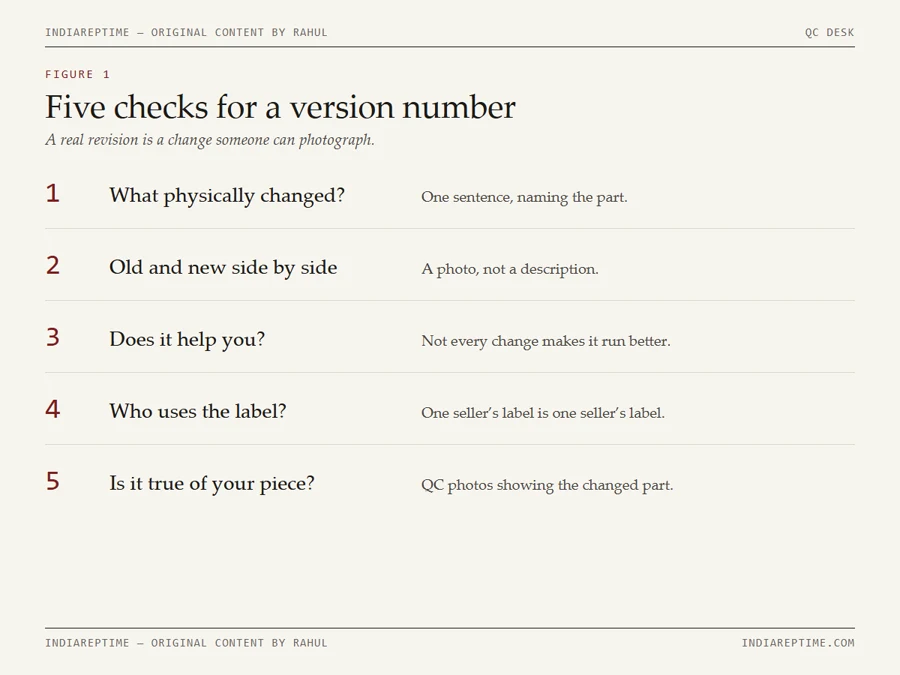
Five checks before you pay extra for a version
- What physically changed? One sentence, naming the part.
- Can I see old and new side by side? A photo, not a description.
- Does the change help me? A different rotor engraving does not make the watch run better.
- Who is using this label? Check whether more than one independent source uses the same number for the same change. One seller’s label is one seller’s label.
- Is it true of my piece? Ask for QC photos of the exact watch showing the changed part. The method is in how to read a QC photo set.
Can a code on the watch prove the version?
Not by itself. Serials and clasp codes can support a claim, and they can be copied like everything else. We went through what they can and cannot show in how to read the serial, the clasp code and the batch.
What about a rumour that a new version is coming?
Treat it like any other factory rumour. A new-version story is a convenient way to clear old stock or to hold a buyer back from a rival. Our red flags for factory rumours apply here without change.
What don’t we know?
- How many versions of any given model really exist. With no registry, nobody can count them.
- Whether a label on a listing matches the watch in the box until the QC photos arrive.
Read next:
- Why are some reps thicker than the gen, and how do you check?
- Rep watch lume: how long should it glow?
- Rotor noise on a rep automatic: normal or a fault?
All reviews and guides · questions? talk to us
Got a question about this, or see it differently? Discuss it on r/IndiaRepTime, our subreddit for owners and first-time buyers.